The emerging awakening of global collective consciousness has been described in various ways: some see it as The Second Coming; others as part of the 2012 agenda; others as somehow involved in the Coming Singularity.
I let each person decide on the emerging wave of global consciousness: here is a link to 'Sufi' Llewellyn Vaughan Lee in a quick video clip explaining his own take on the coming unity.
Tuesday, October 31, 2006


Friday, October 27, 2006
Written in the Sands

A stream, from its source in far-off mountains, passing through every kind and description of countryside, at last reached the sands of the desert. Just as it had crossed every other barrier, the stream tried to cross this one, but it found that as fast as it ran into the sand, its waters disappeared. It was convinced, however, that its destiny was to cross this desert, and yet there was no way. Now a hidden voice, coming from the desert itself, whispered: “The wind crosses the desert, and so can the stream.”
The stream objected that it was dashing itself against the sand, only getting absorbed: that the wind could fly and this was why it could cross a desert.
“By hurtling in your own accustomed way you cannot get across. You will either disappear or become a marsh. You must allow the wind to carry you over to your destination.”
But how could this happen?
“By allowing yourself to be absorbed in the wind.”
This idea was not acceptable to the stream. After all, it had never been absorbed before. It did not want to lose its individuality. And, once having lost it, how was one to know that it could ever be regained?
“The wind,” said the sand, “performs this function. It takes up water, carries it over the desert, and then lets it fall again. Falling as rain, the water again becomes a river.”
“How can I know that is true?”
“It is so, and if you do not believe it, you cannot become more than a quagmire, and even that could take many, many years; and it certainly is not the same as a stream.”
“But can I not remain the same stream that I am today?”
“You cannot in either case remain so,” the whisper said. “Your essential part is carried away and forms a stream again. You are called what you are even today because you do not know which part of you is the essential one.”
When he heard this, certain echoes began to arise in the thoughts of the stream. dimly, he remembered a state in which he - or some part of him, was it? - had been held in the arms of a wind. He also remembered - or did he? - that this was the real thing, not necessarily the obvious thing to do.
And the stream raised his vapour into the welcoming arms of the wind, which gently and easily bore it upwards and along, letting it fall softly as soon as they reached the roof of a mountain, many, many miles away. And because he had had his doubts, the stream was able to remember and record more strongly in his mind the details of the experience. He reflected, “Yes, now I have learned my true identity.”
The stream was learning. But the sands whispered: “We know, because we see it happen day after day: and because we, the sands, extend from the riverside all the way to the mountain.”
And that is why it is said: The way in which the Stream of Life is to continue on its journey is written in the Sands.
The stream objected that it was dashing itself against the sand, only getting absorbed: that the wind could fly and this was why it could cross a desert.
“By hurtling in your own accustomed way you cannot get across. You will either disappear or become a marsh. You must allow the wind to carry you over to your destination.”
But how could this happen?
“By allowing yourself to be absorbed in the wind.”
This idea was not acceptable to the stream. After all, it had never been absorbed before. It did not want to lose its individuality. And, once having lost it, how was one to know that it could ever be regained?
“The wind,” said the sand, “performs this function. It takes up water, carries it over the desert, and then lets it fall again. Falling as rain, the water again becomes a river.”
“How can I know that is true?”
“It is so, and if you do not believe it, you cannot become more than a quagmire, and even that could take many, many years; and it certainly is not the same as a stream.”
“But can I not remain the same stream that I am today?”
“You cannot in either case remain so,” the whisper said. “Your essential part is carried away and forms a stream again. You are called what you are even today because you do not know which part of you is the essential one.”
When he heard this, certain echoes began to arise in the thoughts of the stream. dimly, he remembered a state in which he - or some part of him, was it? - had been held in the arms of a wind. He also remembered - or did he? - that this was the real thing, not necessarily the obvious thing to do.
And the stream raised his vapour into the welcoming arms of the wind, which gently and easily bore it upwards and along, letting it fall softly as soon as they reached the roof of a mountain, many, many miles away. And because he had had his doubts, the stream was able to remember and record more strongly in his mind the details of the experience. He reflected, “Yes, now I have learned my true identity.”
The stream was learning. But the sands whispered: “We know, because we see it happen day after day: and because we, the sands, extend from the riverside all the way to the mountain.”
And that is why it is said: The way in which the Stream of Life is to continue on its journey is written in the Sands.
Via Seeker After Truth
Wednesday, October 18, 2006
Mirrors
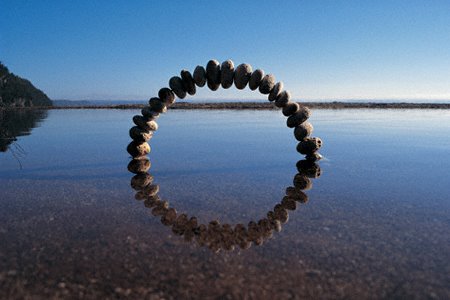
It is said that Reality mirrors itself... a reflection of the thoughts we process, let pass through our body - for the mind does not reside within the 'brain' alone - not the result of the complexity of neurological connections (as reductionist science is fond of thinking)...
No, the mind runs through the whole body... and thus the thoughts we attract and categorise as 'our own' affect the health of the body...
and they also affect how Reality interacts with the person.
Reality mirrors itself
Wednesday, October 11, 2006
Micro-Gravity

This is a picture of a candle burning in micro-gravity.
Yet it still radiates. All things radiate, even when we feel we are in micro-gravity.
We still burn inside... creating our own colours.
Is that we burn each other, as humans?
Afraid of some annihilation...?
Tuesday, October 03, 2006
Filling One's House
An old man on his deathbed called his three sons and told them:
'I can't divide all I have into three parts because I would hand over to you very few possessions. So I have decided to give all I have as an inheritance to the one of you who shows he is the cleverest and most capable. I have left a coin for each one of you on the table - take it. The one of you who buys something with which to fill the house will get everything.' The three sons left home.
The first one bought some straw but he could only fill half the house.
The second son bought bags of feathers but he couldn't fill more than the first brother.
The third son, who got the inheritance, bought just a candle...
...and he waited til night came: he lit the candle and the light filled the house.
'I can't divide all I have into three parts because I would hand over to you very few possessions. So I have decided to give all I have as an inheritance to the one of you who shows he is the cleverest and most capable. I have left a coin for each one of you on the table - take it. The one of you who buys something with which to fill the house will get everything.' The three sons left home.
The first one bought some straw but he could only fill half the house.
The second son bought bags of feathers but he couldn't fill more than the first brother.
The third son, who got the inheritance, bought just a candle...
...and he waited til night came: he lit the candle and the light filled the house.
Saturday, September 23, 2006
10 Things We Didn't Know Last Week
1) Women who attended single-sex schools earn more than those who were taught in mixed schools.
2) Barbie's full name is Barbie Millicent Roberts.
3) A Smurf is three apples tall.
4) Mosquitoes have a sweet tooth, a weakness to be exploited by an anti-malaria project.
5) Four of the top 10 people on the Forbes rich list derive their wealth from the Wal-Mart chain.
6) Eating a packet of crisps a day is equivalent to drinking five litres of cooking oil a year.
7) More than one in four pupils have played truant from school in the past year.
8) Pearl and Dean's a-pa-pa pa-pa theme tune, played in cinemas before the ads, is called Asteroid.
9) Plant seeds that have been stored for more than 200 years can be coaxed into new life.
10) There were no numbers in the very first UK phone directory, only names and addresses. Operators would connect callers.
This list comes from 10 Things We Didn't Know Last Week - see for more details of the above... and keep learning!
2) Barbie's full name is Barbie Millicent Roberts.
3) A Smurf is three apples tall.
4) Mosquitoes have a sweet tooth, a weakness to be exploited by an anti-malaria project.
5) Four of the top 10 people on the Forbes rich list derive their wealth from the Wal-Mart chain.
6) Eating a packet of crisps a day is equivalent to drinking five litres of cooking oil a year.
7) More than one in four pupils have played truant from school in the past year.
8) Pearl and Dean's a-pa-pa pa-pa theme tune, played in cinemas before the ads, is called Asteroid.
9) Plant seeds that have been stored for more than 200 years can be coaxed into new life.
10) There were no numbers in the very first UK phone directory, only names and addresses. Operators would connect callers.
This list comes from 10 Things We Didn't Know Last Week - see for more details of the above... and keep learning!
Wednesday, September 20, 2006
Idries Shah Speaks...

TRUTH: ‘From time to time ponder whether you are unconsciously saying: ‘Truth is what I happen to be thinking at this moment’
COMMON KNOWLEDGE: ‘The more you look at ‘common knowledge’, the more you realise that it is more likely to be common than it is to be knowledge. No real knowledge is common’
SOCIETY: ‘You say that this society will come to an end, because societies always have done so. I wonder whether they have ended because they were not really societies at all’
BOOKS AND DONKEYS: ‘Anyone can see that an ass laden with books remains a donkey. A human being laden with the undigested results of a tussle with thoughts and books, however, still passes for wise’
QUESTIONS AND ANSWERS: ‘One of the big differences between questions and answers is that, a question may be asked at almost any time and place, but its answer may come at a special time and place’
Idries Shah - 'Reflections'
Tuesday, September 12, 2006
The Position
A time to reflect back on some of Gurdjieff's words...
George Gurdjieff explained our situation this way:
"There is an Eastern tale which speaks about a very rich magician who had a great many sheep. But at the same time this magician was very mean. He did not want to hire shepherds, nor did he want to erect a fence about the pasture where his sheep were grazing. The sheep consequently often wandered into the forest, fell into ravines, and so on, and above all they ran away, for they knew that the magician wanted their flesh and skins and this they did not like.
"At last the magician found a remedy. He hypnotized his sheep and suggested to them first of all that they were immortal and that no harm was being done to them when they were skinned, that, on the contrary, it would be very good for them and even pleasant; secondly he suggested that the magician was a good master who loved his flock so much that he was ready to do anything in the world for them; and in the third place he suggested to them that if anything at all were going to happen to them it was not going to happen just then, at any rate not that day, and therefore they had no need to think about it. Further the magician suggested to his sheep that they were not sheep at all; to some of them he suggested that they were lions, to others that they were eagles, to others that they were men, and to others that they were magicians.
"And after this all his cares and worries about the sheep came to an end. They never ran away again but quietly awaited the time when the magician would require their flesh and skins.
"This tale is a very good illustration of man's position."
How good...? How timely...?
George Gurdjieff explained our situation this way:
"There is an Eastern tale which speaks about a very rich magician who had a great many sheep. But at the same time this magician was very mean. He did not want to hire shepherds, nor did he want to erect a fence about the pasture where his sheep were grazing. The sheep consequently often wandered into the forest, fell into ravines, and so on, and above all they ran away, for they knew that the magician wanted their flesh and skins and this they did not like.
"At last the magician found a remedy. He hypnotized his sheep and suggested to them first of all that they were immortal and that no harm was being done to them when they were skinned, that, on the contrary, it would be very good for them and even pleasant; secondly he suggested that the magician was a good master who loved his flock so much that he was ready to do anything in the world for them; and in the third place he suggested to them that if anything at all were going to happen to them it was not going to happen just then, at any rate not that day, and therefore they had no need to think about it. Further the magician suggested to his sheep that they were not sheep at all; to some of them he suggested that they were lions, to others that they were eagles, to others that they were men, and to others that they were magicians.
"And after this all his cares and worries about the sheep came to an end. They never ran away again but quietly awaited the time when the magician would require their flesh and skins.
"This tale is a very good illustration of man's position."
How good...? How timely...?
Sunday, September 10, 2006
Laughter in the womb

Like Attracts Like... the thoughts we give out, whether we verbalise them or not, shape how this universe responds and conspires with us... it is a cosmic imagination that we wander in... and so laughter keeps us on a sane journey:
"Locked double doors blow open.
Water pours. Fire catches. Wind breaks up!
The Spring ground lifts a little finger.
It's all laughing." Rumi
What have You come for?....
"I have come into this world to hear this:
every song the earth has sung
since it was conceived in the
Divine’s womb and began
spinning from
His wish" Hafiz
Thursday, August 31, 2006
Then there is Kyron
Much has been talked about concerning the New Energies that have shifted into alignment on this planet. These energies are different from the old frequencies, and are here in order to assist in the 'phase change'.
Useful in this regard is the channeled information given by the Kyron. Of note is the recent UN 2006 Channeling.
For some, this material will not seem appropriate. For others, it may appear to come at the right time. You may 'warm' to it or not.
This is for you to decide.
Useful in this regard is the channeled information given by the Kyron. Of note is the recent UN 2006 Channeling.
For some, this material will not seem appropriate. For others, it may appear to come at the right time. You may 'warm' to it or not.
This is for you to decide.
Thursday, August 24, 2006
A Spy of the Heart
Seeker of Truth Robert Darr became interested in Sufism through the writings of Idries Shah, and was the member of a Shah group for over 10 years. Then he decided to learn Persian and travel to Afghanistan to see what was really behind it all.
Robert Darr draws a distinction between Shah’s writing (which he sees as working) and the groups which Shah directed, which he describes as all being problematic. He writes that his meeting and spending time with the Sufi Ustad Khalili liberated him from that structure.
Robert subsequently converted to Islam and became Robert Abdul Hayy Darr. His book of travels and encounters in Afghanistan is called 'The Spy of the Heart'. From the forward:
'Between 1985 and 1990 I travelled in and out of Afghanistan delivering medicines and humanitarian aid to those affected by the war with the Soviet Union. I learned Persian while working with the refugees and became friends with many of them. While there I observed how the war brought religious fanatics to power and attracted militant zealots from all over the Islamic world, and how the United States funded organizations that preceded and helped shape the Taliban. These were seeds that would lay the groundwork for the events of September 11th, 2001.
Although it includes some political analysis, this book is also an exploration of Islamic spirituality. It was within the chaotic setting of the Afghan war and its sectarian struggles that I was drawn into the heart of Islam—ultimately to convert. After decades studying Afghan culture and spirituality, I felt it was time to share what I have learned from my companionship with various teachers of Islam and from my efforts to follow the Sufi way.'
The book is available online as an e-book here.
Robert Darr draws a distinction between Shah’s writing (which he sees as working) and the groups which Shah directed, which he describes as all being problematic. He writes that his meeting and spending time with the Sufi Ustad Khalili liberated him from that structure.
Robert subsequently converted to Islam and became Robert Abdul Hayy Darr. His book of travels and encounters in Afghanistan is called 'The Spy of the Heart'. From the forward:
'Between 1985 and 1990 I travelled in and out of Afghanistan delivering medicines and humanitarian aid to those affected by the war with the Soviet Union. I learned Persian while working with the refugees and became friends with many of them. While there I observed how the war brought religious fanatics to power and attracted militant zealots from all over the Islamic world, and how the United States funded organizations that preceded and helped shape the Taliban. These were seeds that would lay the groundwork for the events of September 11th, 2001.
Although it includes some political analysis, this book is also an exploration of Islamic spirituality. It was within the chaotic setting of the Afghan war and its sectarian struggles that I was drawn into the heart of Islam—ultimately to convert. After decades studying Afghan culture and spirituality, I felt it was time to share what I have learned from my companionship with various teachers of Islam and from my efforts to follow the Sufi way.'
The book is available online as an e-book here.
Saturday, August 19, 2006
Effort...and moving forwards
Living through experiences requires gaining tastes: when specific tastes have been acquired they can then resonate with other 'experiences beyond the veil' - as like attracts like. Pushing through these experiences require effort, and trust in oneself... and letting go the trivial.
As Idries Shah says in 'Knowing How to Know':
'When people have a hard task to do - one which stretches them - they become less concerned with trivial matters. If you have not registered this yet, observe it in yourself and in others, and you will see that it is true.
When there is an emergency, for example, something which takes up a great deal of attention, triviality is reduced. In order to enable people to be less trivial, and to tackle things which really help them develop, they should undertake tasks which provide the right kind and degree of stretching.
People who have achieved great things, genuinely effective accomplishments, will be found to have done so through this method: stretching. When it goes wrong, people apply stress, not stretching. Stress is damaging and does not product constructive results.
Mistaking stretching for straining: labour for exercise, is what causes a great deal of trouble.
When triviality disappears, even temporarily, people are able to work at a higher level. This is true of all kinds of human endeavour: it is to be seen in attainment of all kinds and also even in a social milieu: people who are less trivial are more respected.'
As Idries Shah says in 'Knowing How to Know':
'When people have a hard task to do - one which stretches them - they become less concerned with trivial matters. If you have not registered this yet, observe it in yourself and in others, and you will see that it is true.
When there is an emergency, for example, something which takes up a great deal of attention, triviality is reduced. In order to enable people to be less trivial, and to tackle things which really help them develop, they should undertake tasks which provide the right kind and degree of stretching.
People who have achieved great things, genuinely effective accomplishments, will be found to have done so through this method: stretching. When it goes wrong, people apply stress, not stretching. Stress is damaging and does not product constructive results.
Mistaking stretching for straining: labour for exercise, is what causes a great deal of trouble.
When triviality disappears, even temporarily, people are able to work at a higher level. This is true of all kinds of human endeavour: it is to be seen in attainment of all kinds and also even in a social milieu: people who are less trivial are more respected.'
Thursday, August 17, 2006
Leave differently

Leave differently from how you came.
Everything that you need exists in this present moment, and this moment is all that exists.
A brief flicker - brighter that atomic sparkles.
In the nowness of now.
Tuesday, August 15, 2006
What holds us together

Everything spins in its own orbit: nothing stays still or static. What holds us in these orbits? What is the force that compels creation?
Creation is formed from one force only. Negativity cannot create - it does not have that kind of power. Creation is the force of attraction. Everything is pulled together: a life is lived through attraction. The coming together.
Everything conspires towards this coming together. Even those things we thought of as a hindrance: shade protects us from the sun; darkness allows rest and brings the dawn; hurt allows us to experience the absence of joy.
There is nothing that is not: all is
Subscribe to:
Posts (Atom)